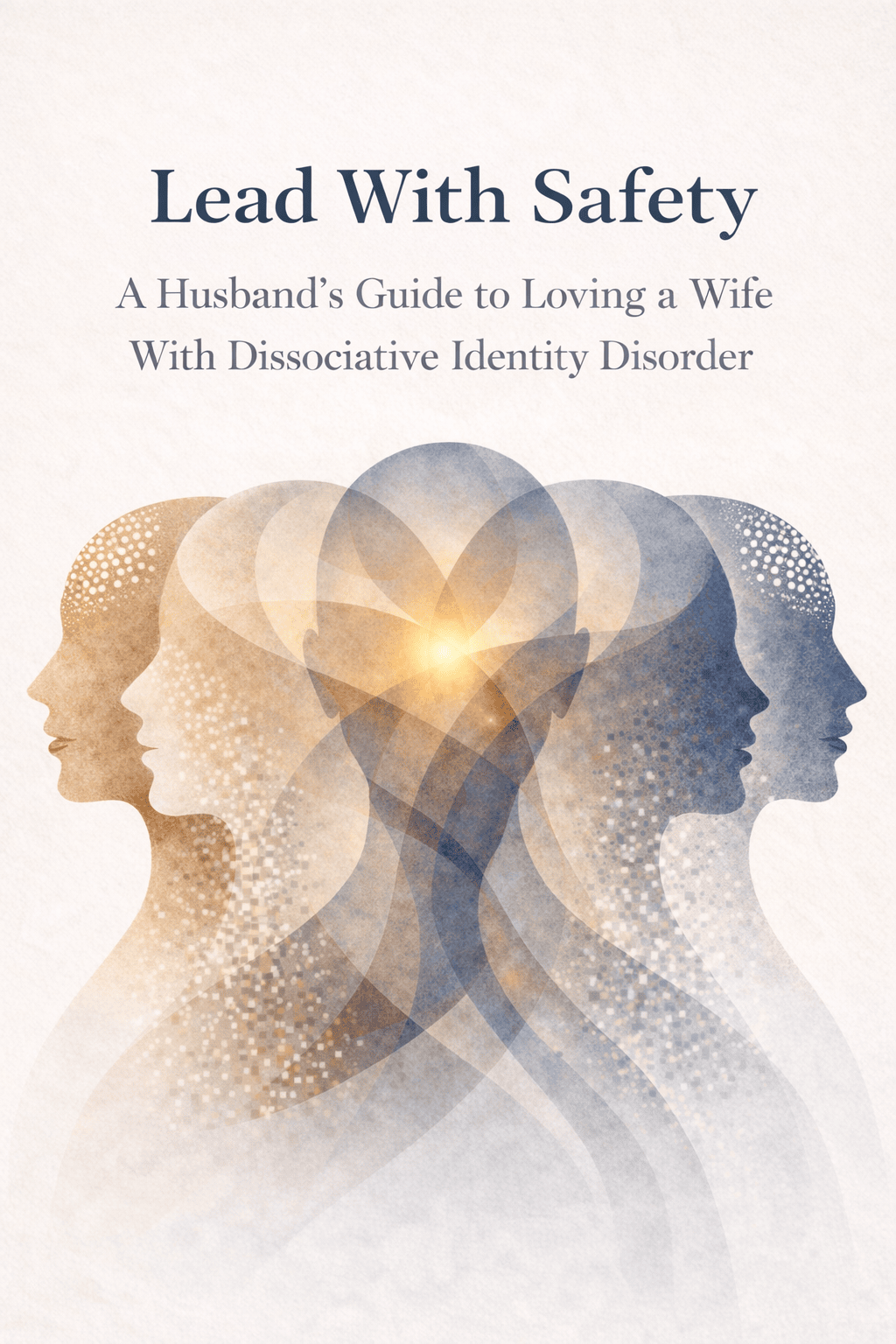
A Book for the Man No One Wrote For

Leading with Safety

A Husband's Guide to Loving a Wife with DID

There is no book for the husband. The clinical world focuses on her. The therapy focuses on her system. And you're left standing in your own kitchen wondering what just happened, why nothing you say lands, and whether the marriage you thought you had ever actually existed.

By Scott Beach

Read the Story Behind the Book
Leading with Safety book cover

"You're often not arguing with your wife. You're standing in front of a survival response wearing her face."

Chapter Two

"You can't outlove, out-reason, or explain the fear away."

Chapter One

"Safety is what allows love to be received."

Chapter One

"It is far better to be happy than to be correct."

Chapter Four

The Little Fishy Song

There's one moment I return to when people ask me why this book exists.

It wasn't in a therapy office.
Not in research.
Not in training.

It was in my own bed.

I know with complete certainty the very moment I decided to write this book.

It was because of a Little.

Going to bed one night, I suddenly realized that the woman beside me had switched. I was no longer going to bed with my wife, but with her Little. I had met her before, but she seldom spoke.

She would curl up so close to me and hold me so tight.

My wife says that when she sees her internally, she's always running. When she fronts, her feet are constantly moving. Now I can tell she's on her way just by the way my wife's feet move as she drifts off to sleep.

This night was different.
This night she decided to speak to me.

It was about music.

I generally play soft music on a speaker beside my bed at night. She looked up at me and spoke in a childlike voice I had never heard before.

She had a lisp and a slight stutter, which is exactly what my wife had told me in the past and laughed about when describing how she spoke growing up.

The Little asked me about the music. She had never heard anything like it before. I told her who it was. That it was a genre she probably hadn't heard.

I wanted to know her.
I wanted to learn about her.

So I asked her, "What's your favorite song?"

I don't know what I was expecting. She's around five years old and believed it was 1985. I was expecting a Cyndi Lauper song or something similar.

She looked up at me with her big brown eyes and said,

"The Little Fishy Song."

In an instant, my heart and soul shattered and I was someone new.
Someone whose entire outlook shifted.

I know the research. I've read every study, every source in the bibliography at the end of this work.

I know the science. I know the theories.

At that moment there was a shift.

I went from knowing
to feeling.

I switched.

I knew that the abuse she endured happened at an extremely early age. But when she said "The Little Fishy Song," I suddenly felt the horror she endured as a child.

As a child.

She endured the unspeakable.
She survived it.

And I felt it in every part of me, not as a realization but as something that moved through me all at once, through my chest, my thoughts, something deeper than that, until there was nothing in me that hadn't been touched by it.

It was not something I processed.

As a rupture.
It took me over.

Like switching.

Like being dropped into a new version of myself without warning, without preparation, and knowing immediately that I could never go back.

I wasn't seeing the same world anymore.

I wasn't the same person in it.

Everything I thought I understood collapsed. Everything I had been holding onto to make sense of it was gone.

And what replaced it was a simple, brutal, unavoidable truth.

I was wrong.

I had been seeing her wrong. Responding wrong. Trying to control something I didn't understand.

And for the first time, I saw the only place left to look.

Myself.

I am the only person I can change.
The only person I have control over.
The only person responsible for how I show up in this.

And in that moment, it was not a decision.
It was not a question.

It was a knowing.

I had to become different.

Everything shifted.

Everything switched.

I went from seeing myself as the victim of what had happened in our marriage to understanding that it wasn't personal.

It wasn't because she didn't love me. It wasn't that she didn't value our marriage. It wasn't intentional. It wasn't malicious.

That wasn't it.
That wasn't it at all.

She was a completely innocent victim.
A victim of something she couldn't control, couldn't fight, couldn't escape. She lived through terror.

And it all hit me at once. Not one thought after another.
All of them. At the same time.

And in that moment, I made a decision I didn't even feel like I was making.

I was going to be the one who kept her safe. That she would never feel that kind of fear again. That I would protect her, emotionally and mentally.

Because my love wasn't what was missing.

Safety was.

From that moment on, I knew.

My job as a husband wasn't to problem solve and love more.

It was:

To Lead With Safety

This book exists because no one else wrote it.

When a wife has Dissociative Identity Disorder, the focus goes to her. Her trauma. Her system. Her therapy. What gets missed is the marriage itself, and how it becomes an environment that either increases safety or increases instability for both of you.

Leading with Safety is written from inside a real marriage, by a husband who has made mistakes, reacted poorly, burned out, tried to fix what couldn't be fixed, and learned, often the hard way, that love alone is not enough.

This isn't a clinical guide. It won't teach you diagnostic language or show you how to stop dissociation. What it offers is a different framework: a way to understand your role through something more practical than love and more sustainable than willpower.

Safety is what changes the nervous system. Safety is what allows connection. Safety is what will make long-term stability possible.

The Beach Safety Model

At the core of this book is an original framework called Sequential Safety. The idea is simple: safety is not a single thing you provide. It is a series of levels, each one building on the one before it. You cannot skip ahead. You cannot rush it. And if a lower level collapses, everything above it goes with it.

1

Nervous System Safety

Is her body calm enough to be present? This is physiological. Below conscious control. Nothing else works until this is in place.

2

Emotional Safety

Can she feel what she's feeling without it being corrected, minimized, or redirected? Can emotion exist in the room without becoming a problem to solve?

3

Relational Safety

Does she feel safe with you specifically? Not in theory. Right now, in this moment, in this room.

4

Communicative Safety

Can she engage with content? Process what you're saying? Offer her own perspective without defending against yours?

5

Reflective Safety

She's naming her own patterns. Making connections. This is rare. It shows up when the lower levels have been safe long enough.

Most of the worst moments in a marriage shaped by trauma happen because the husband is operating at Level 4 while his wife's system is at Level 1. The Beach Safety Model gives you a way to read the room in real time, and respond to the level that's actually present.

"Understanding the reality doesn't fix the marriage. It forces you to decide who you're going to be inside it."

The Bridge

"When safety is present, love has somewhere to go. When safety is absent, love becomes noise."

Chapter One

"That's not leadership. That's self-abandonment that just looks like strength from the outside."

Chapter Eight

"Not the sentence. She will learn
You."

Epilogue

If you recognize yourself here, this was written for you.

17 Chapters. Two Parts. One Question.

Part One: Seeing Clearly
01Why Love Alone Is Not Enough
02Trauma Time and Present Time
03Why Reactions Look Like Choices
04The Collapse of the Husband's Role
05Why Fixing Makes Things Worse
06What the Marriage Becomes Under Trauma
07The Question That Changes Everything
Part Two: Acting Differently
08Regulating Yourself First
09The Beach Safety Model
10Conflict Without Damage
11Intimacy, Sexuality, and Consent
12Aftercare, Repair, and Reconnection
13When You Become the Trigger
14When You Are the One Who Is Exhausted
15Her Therapist and You
16When Leaving Is the Question
17What the Marriage Looks Like Now

Scott Beach

This book was written by a husband living with a wife who has Dissociative Identity Disorder. But it wasn't written by a husband alone.

The Husband
Lived Experience

Years inside a marriage shaped by dissociation. Every story in this book is real. Every failure is his. Every lesson was learned the hard way, inside the same rooms he's still standing in.

The Pharmacist
Neural Science

As a registered pharmacist, Scott understands the nervous system at the molecular level. The neuroscience in this book isn't borrowed from popular summaries. It's understood from the ground up.

The Clinician
Clinical Skill

As a substance abuse clinical therapist, Scott learned to read dysregulation in real time, to de-escalate activated systems, and to hold space for people in crisis. Those clinical skills are present on every page.

All three are present in this book. The husband provides the honesty. The pharmacist provides the science. The clinician provides the framework. No other author in this space carries all three.

The Beach Safety Model, the framework at the center of this book, is his original contribution. Built from lived experience and tested against the clinical research of Porges, van der Kolk, Siegel, Fisher, and others, it offers the first structured safety hierarchy designed specifically for the partner of someone with a dissociative system.

He lives with his wife and children. The marriage described in this book is ongoing. The work described in this book is ongoing. Nothing in these pages is written from the other side of something finished. It is written from inside something that is still being built.

"When everything starts to spiral, you don't need ten strategies. You need one question. Is this moment safe?"

Coming Soon