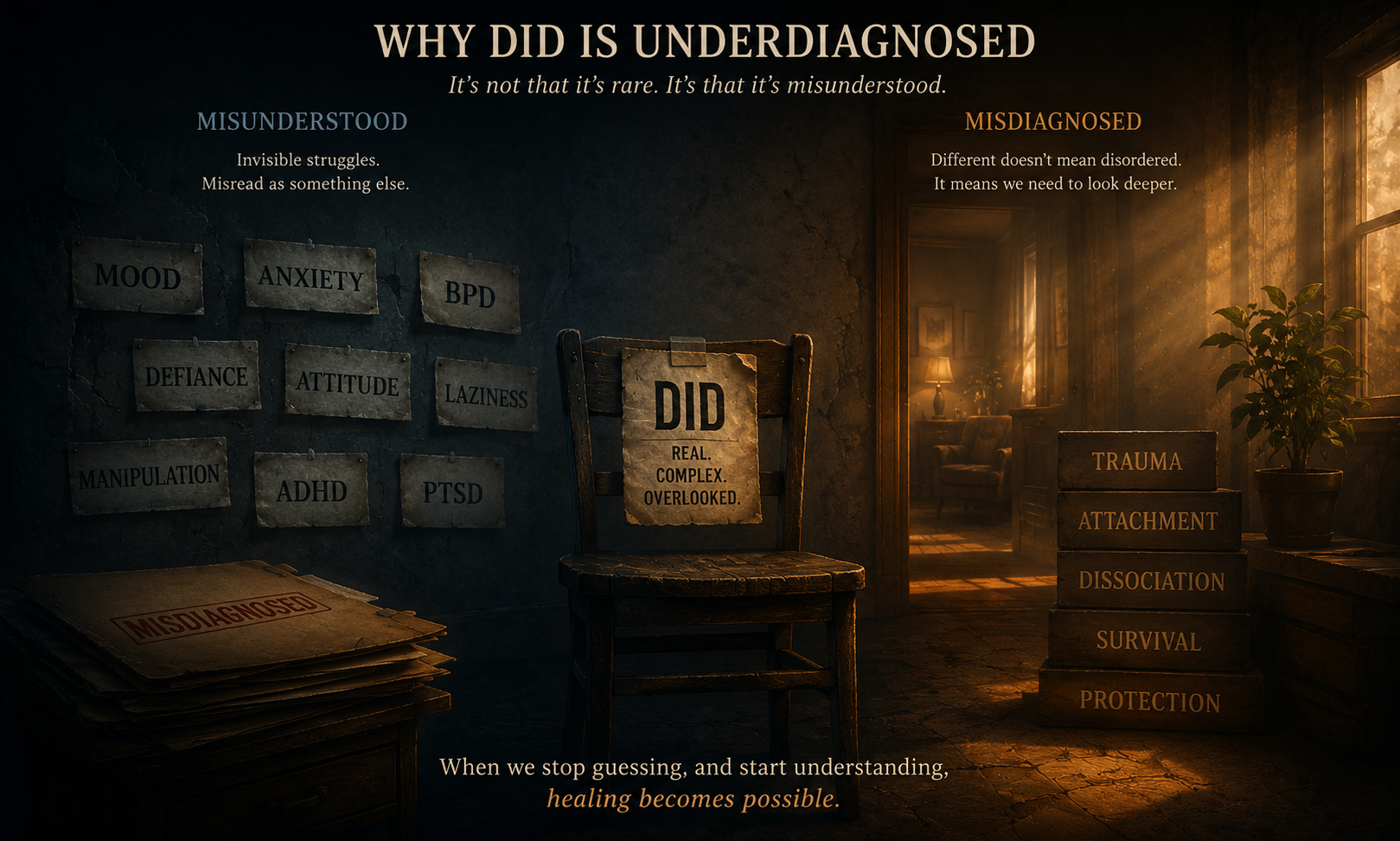
Dissociative identity disorder is underdiagnosed less because it is vanishingly rare than because it is covert, polysymptomatic, and assessed with the wrong interview frame. Structured studies repeatedly find dissociative disorders in community and clinical populations at rates far above what many clinicians were taught, while also showing that most affected patients had not previously been recognized as having a dissociative disorder.
The strongest recurring reasons for missed diagnosis are diagnostic overlap with borderline personality disorder, schizophrenia-spectrum and other psychotic disorders, and ADHD; clinician education gaps about dissociation and trauma; failure to ask direct questions about amnesia, identity discontinuity, and internal voices; and system-level pressures that reward brief, familiar diagnoses over time-intensive differential assessment.
The evidence linking dissociation to childhood interpersonal trauma is robust at the transdiagnostic level and substantial in DID specifically. Meta-analysis shows higher adult dissociation among people exposed to childhood abuse or neglect, with especially high scores in sexual and physical abuse, and greater dissociation when abuse starts earlier, lasts longer, or is perpetrated by caregivers. When DID is dismissed as too rare to be clinically relevant, the implied picture is hard to reconcile with both the prevalence of severe childhood victimization and the repeated finding that chronic complex dissociation clusters in precisely those trauma-exposed groups.
Why DID Is Missed in Ordinary Practice
The best concise explanation comes from the ISSTD adult treatment guidelines: DID is commonly missed because clinicians are taught to expect a dramatic, obvious presentation, while most patients present instead with a polysymptomatic mixture of dissociative symptoms, PTSD symptoms, depression, panic, substance misuse, somatic complaints, and eating-disordered symptoms. Many standard psychiatric interviews do not ask about dissociation or trauma at all. The sine qua non of diagnosis is that the clinician must actually inquire about dissociative symptoms.
That is consistent with the classic outpatient prevalence study by Foote and colleagues: among psychiatric outpatients who received structured diagnostic assessment, 29% met criteria for a dissociative disorder and 6% met criteria for DID, yet chart review showed that only 5% of those identified during the study had previously been given a dissociative-disorder diagnosis. Even where prevalence was substantial, prior recognition was minimal.
System pressures compound the clinical problem. Proper differential diagnosis of DID often requires a long trauma history, collateral information when available, and structured interviews that can take 45 to 180 minutes or more in the case of the SCID-D-R. By contrast, ordinary service settings often operate through brief encounters and high-throughput treatment models. A survey of people with dissociative symptoms found that structural barriers including finances, insurance, and lack of provider availability were the most commonly endorsed obstacles to accessing and continuing care.
There is also a classification problem. DSM-5 widened DID recognition by allowing identity disruption to be reported as well as observed, by recognizing amnesia for everyday as well as traumatic events, and by including pathological possession-form presentations in some cultures. ICD-11 goes further by distinguishing DID from partial DID, a presentation dominated by intrusions from non-dominant self-states with less recurrent executive takeover, which highlights a clinically important gray zone that may be coded inconsistently across systems.
Diagnostic Overlap with BPD, Psychotic Disorders, and ADHD
The reason DID is so easy to misfile is not that it has one or two unique symptoms; it is that its core pathology can be expressed through symptom clusters that already belong to more familiar diagnoses. This is especially true for emotion dysregulation and self-harm with BPD, voice-hearing and thought-insertion phenomena with psychotic disorders, and concentration failure or “blanking out” with ADHD.
DID and BPD
DID and BPD overlap clinically enough that confusion is predictable, but the overlap is not identity-level equivalence. BPD includes unstable relationships, self-image instability, impulsivity, self-harm, and transient psychotic symptoms under stress; DID includes a more specific syndrome of recurrent self-state discontinuity and amnesia. The ISSTD guidelines explicitly warn that identity problems in personality-disordered patients may be mistaken for DID, while also noting that careful use of tools such as the DES, SCID-D, and MID helps with the differential.
Dissociation is common in BPD, tightly linked to trauma, and clinically impairing. A trauma-exposed, self-harming, emotionally labile patient can satisfy many clinicians’ expectations for BPD before anyone investigates dissociative amnesia, internal voice phenomenology, or state-dependent shifts in agency. That is one reason BPD can function as both a true comorbidity and a diagnostic “landing pad” for dissociative pathology.
A representative case report from 2022 illustrates the point: a woman met DSM-5 criteria for both DID and BPD, showing that a BPD diagnosis does not rule DID out. The clinical lesson is not that all BPD is missed DID, but that the coexistence of the two disorders is real enough that clinicians should not stop the assessment once a BPD formulation is available.
DID and Schizophrenia-Spectrum Disorders
The most common shortcut in practice is to treat voice-hearing as psychosis until proven otherwise. That shortcut is unsafe diagnostically. A 2023 comparative study of DID and schizophrenia-spectrum disorders found that people with DID tended to experience voices as more internally located and internally generated than people with schizophrenia-spectrum disorders, whereas the schizophrenia group showed more metaphysical interpretations of voices, more incoherence, and more word substitution once covariates were considered. The overlap is real, but the phenomenology is not identical.
The ISSTD guideline states the practical distinction clearly: clinicians should not confuse psychotic auditory hallucinations with the complex, personified, mostly inner voices often described by DID patients as communications among alternate identities. Such DID-related hallucinatory phenomena are often not eliminated by antipsychotics unless there is true comorbid psychosis. “Voices equals schizophrenia” is too crude a diagnostic shortcut.
DID and ADHD
The DID-vs-ADHD literature is much thinner than the DID-vs-BPD or DID-vs-psychosis literature, which is itself part of the problem. Trauma-related dissociation and ADHD symptoms overlap enough to create regular confusion around distractibility, zoning out, emotional dysregulation, task failure, forgetfulness, and poor concentration.
A 2022 latent-class study found that higher dissociation clustered with more attention problems and that high-dissociation groups also showed greater childhood adversity, including sexual abuse. The ISSTD guideline warns that differentiating dissociative attentional problems from genuine attention-deficit disorder may be difficult and requires careful attention to the context and nature of the apparent ADHD symptoms. A useful clinical distinction: ADHD produces a trait-like, developmentally persistent attentional pattern, whereas dissociative attentional failure is more often state-dependent, especially around trauma cues, internal conflict, depersonalization, or amnestic episodes.
Prevalence and Why Rarity Claims Are Hard to Defend
The prevalence literature is heterogeneous, but the consistent message is that DID is not well described by the phrase “so rare that ordinary clinicians can ignore it.” In the community, individual studies have reported DID rates around 0.4%, 1.1%, 1.5%, and 3.1%, while broader dissociative-disorder prevalence has often been much higher. In psychiatric settings, DID estimates rise further, especially when structured dissociation-specific interviews are used.
A key methodological point: general psychiatric assessment instruments usually do not detect dissociative disorders well, which biases large epidemiologic studies downward unless dissociation-specific tools are added.
Community-based work by Johnson and colleagues found 1.5% past-year DID prevalence and 4.4% DDNOS prevalence in adults, with all dissociative diagnoses associated with impaired functioning. That single study already undermines the idea that DID-like dissociative pathology is meaningful only in specialist clinics.
A useful comparison: WHO estimates schizophrenia affects about 0.29% of the global population. Even conservative DID community estimates around 1% to 1.5% would therefore place DID in a prevalence range that is not obviously lower than schizophrenia. Calling DID “too rare to screen for” is harder to defend when even conservative community estimates are not trivial.
Trauma, Childhood Abuse, and the Plausibility Problem
The empirical association between severe childhood interpersonal trauma and dissociation is strong. A meta-analysis of 65 studies found higher dissociation in adults exposed to childhood abuse or neglect than in comparison groups, with the highest dissociation scores in sexual and physical abuse, and with earlier onset, longer duration, and parental perpetration predicting more severe dissociation.
WHO estimates that up to 1 billion children aged 2-17 experience physical, sexual, or emotional violence or neglect in a given year, and WHO’s child-maltreatment data states that 1 in 5 women and 1 in 7 men report childhood sexual abuse. A 2025 JAMA Pediatrics meta-analysis similarly estimated substantial worldwide prevalence of sexual violence against children.
Against that backdrop, the claim that chronic complex dissociative sequelae are so rare as to be clinically negligible requires either believing that extreme, repeated early trauma is itself exceptionally uncommon, or believing that such trauma very rarely produces major dissociative pathology. Neither assumption fits the broader evidence.
High prevalence of childhood abuse does not mean high prevalence of DID, and trauma exposure alone does not diagnose DID. The cleaner conclusion: rarity claims become implausible when they ignore both the scale of childhood victimization and the repeated association between severe early interpersonal trauma and dissociation. The clinically responsible response is neither dismissal nor credulity, but better assessment.
Assessment Tools and a More Reliable Diagnostic Pathway
The strongest empirical support among diagnostic tools belongs to the SCID-D family. A 2021 meta-analysis found that SCID-D interviews robustly differentiated dissociative from non-dissociative disorders, with a very large overall effect size and especially strong differentiation on amnesia and identity alteration. When clinicians use a dissociation-specific structured interview, diagnostic separation improves substantially.
The ISSTD guideline describes the major tools in practical terms:
- SCID-D-R — a 277-item clinician-administered interview assessing five dissociative symptom areas; may take 45 to 180 minutes or more. Gold standard for differential diagnosis.
- DDIS — shorter clinician-administered interview; also assesses BPD, somatization, Schneiderian first-rank symptoms, trance, and childhood abuse.
- MID — a 218-item multiscale self-report with validity indicators that can generate diagnostic impressions including DID and PTSD.
- DES — best understood as a screening instrument, not a stand-alone diagnostic test.
A practical assessment sequence that best matches the literature:
- Ask directly about dissociation. Ask about lost time, “coming to,” internal voices, made thoughts or urges, depersonalization, derealization, and contradictory self-states. DID is frequently missed when clinicians do not ask focused questions at all.
- Clarify voice phenomenology. Internal vs. external location, personification, relationship to self-states, reality testing, metaphysical beliefs. Phenomenology helps separate DID from primary psychosis.
- Screen before concluding. Use the DES or equivalent when trauma, amnesia, voices, unexplained seizures, severe self-harm, or identity confusion are present.
- Follow positive screens with structured assessment. Use SCID-D, DDIS, and/or MID. Structured tools outperform generic interviewing for differential diagnosis.
- Assess trauma and amnesia carefully. Explore childhood interpersonal trauma, but do not assume intact recall. Dissociative amnesia can make childhood abuse harder to report directly.
- Rule out and rule in comorbidity. Evaluate BPD, PTSD/CPTSD, psychotic disorders, bipolar disorder, ADHD, seizures, substance effects, and neurologic conditions. DID is often comorbid rather than diagnostically isolated.
Controversies and Open Questions
There are real controversies. The field continues to debate etiologic mechanisms, especially the relative weight of trauma models, sociocognitive accounts, and broader transtheoretical frameworks. A 2022 Annual Review article argued that disagreements are often more about origins and mechanisms than about whether dissociative fragmentation is clinically observable. The fact that etiologic debates persist does not justify ignoring dissociative pathology in clinical work.
False-positive diagnosis is also a real concern. The 2021 study on false-positive and imitated DID concluded that unclear diagnostic guidance can make differentiation difficult and warned that some patients may identify strongly with DID narratives that do not match full dissociative-disorder phenomenology. The literature supports both halves of the claim: DID is missed in some patients and over-attributed in others. The remedy for both errors is the same: slower, better differential diagnosis.
DID is most likely to be missed when clinicians treat dissociation as rare, voices as automatically psychotic, identity disturbance as automatically borderline, and attentional fragmentation as automatically ADHD. The evidence does not support making any of those shortcuts routine. The best-supported alternative is dissociation-specific inquiry followed by structured assessment when indicated.
Selected References
- Boysen GA. Dissociative Identity Disorder: A Review of Research From 2011 to 2021. Journal of Nervous and Mental Disease. 2024;212(3):174-186.
- Mychailyszyn MP et al. Differentiating Dissociative from Non-Dissociative Disorders: A Meta-Analysis of the SCID-D. Journal of Trauma & Dissociation. 2021;22(1):19-34.
- Dorahy MJ et al. A comparison between auditory hallucinations in dissociative identity disorder and schizophrenia spectrum disorders. Journal of Clinical Psychology. 2023;79(9):2009-2022.
- Johnson JG et al. Dissociative disorders among adults in the community, impaired functioning, and axis I and II comorbidity. Journal of Psychiatric Research. 2006;40(2):131-140.
- Foote B et al. Prevalence of dissociative disorders in psychiatric outpatients. American Journal of Psychiatry. 2006;163(4):623-629.
- Sar V. Epidemiology of Dissociative Disorders: An Overview. Epidemiology Research International. 2011;2011:404538.
- Vonderlin R et al. Dissociation in victims of childhood abuse or neglect: a meta-analytic review. Psychological Medicine. 2018;48(15):2467-2476.
- Piolanti A et al. Global Prevalence of Sexual Violence Against Children. JAMA Pediatrics. 2025;179(3):264-272.
- Krause-Utz A. Dissociation, trauma, and borderline personality disorder. Borderline Personality Disorder and Emotion Dysregulation. 2022;9(1):14.
- Pietkiewicz IJ et al. Revisiting False-Positive and Imitated Dissociative Identity Disorder. Frontiers in Psychology. 2021;12:637929.
- ISSTD. Guidelines for Treating Dissociative Identity Disorder in Adults, Third Revision. Journal of Trauma & Dissociation. 2011;12(2):115-187.
- Spiegel D et al. Dissociative disorders in DSM-5. Depression and Anxiety. 2011;28:E17-E45.
- Bachrach N, Huntjens RJC. Recent evidence-based developments in the treatment of DID. Frontiers in Psychiatry. 2025;16:1650164.